
Fixed Income Mutual Funds
A Lower-Volatility Investment Option for Indian Investors
Understand how fixed income mutual funds work, where they invest, the risks involved, and how they can fit into your investment portfolio.
How Much Money Is Invested in These Funds?
Official mutual fund industry data shows that open-ended debt schemes alone managed approximately ₹19.33 lakh crore as of 31 August 2026.
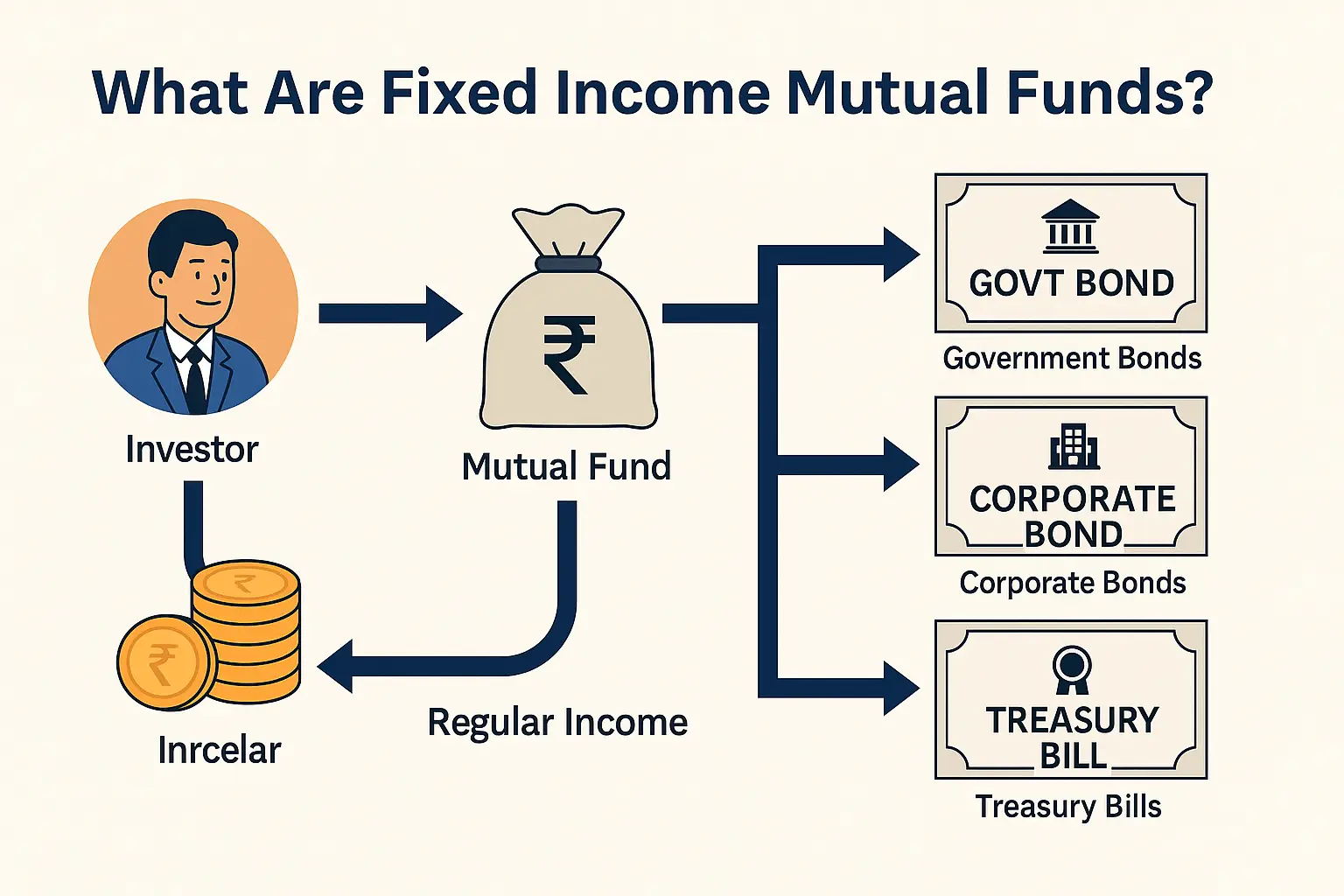
The broader fixed-income mutual fund universe is even larger when debt index funds, debt ETFs, close-ended debt schemes, and other fixed-income products are considered. This shows that debt-oriented mutual funds are an important part of India's investment market.
A large AUM does not mean a fund is guaranteed, safer, or suitable for every investor. Scheme selection should depend on your investment horizon, credit risk, duration risk, liquidity needs, and tax position.
How to Choose a Fixed Income Mutual Fund
There is no single “best” fixed income mutual fund for every investor. The right fund depends on how long you want to invest, how much risk you can accept, and what role the investment will play in your portfolio.
Before selecting a scheme, check these factors:
Past Performance
Review performance across different interest-rate cycles instead of relying only on the latest one-year return.
Credit Quality
Check the credit ratings and issuer concentration of the bonds held in the portfolio.
Duration Risk
Longer-duration funds can move more sharply when market interest rates change.
Expense Ratio
Lower ongoing costs leave more of the scheme's gross return available to investors, all else being equal.
Portfolio Liquidity
Understand how easily the securities held by the scheme can be sold during stressed market conditions.
Investment Horizon
Match the fund's duration and strategy with the period for which you actually plan to keep your money invested.
What Kind of Returns Do Fixed Income Mutual Funds Offer?
Fixed income mutual fund returns are market-linked, not guaranteed. The scheme's return mainly comes from interest earned on its securities and changes in their market value.
Interest Income
Bonds and other debt securities generally pay coupon or interest income to the fund. This income contributes to the scheme's overall return.
Changes in Bond Prices
Bond prices can rise or fall as market interest rates, credit perceptions, liquidity, and demand change.
NAV Movement
The scheme's NAV reflects the combined effect of accrued income, changes in security values, fund expenses, and other portfolio movements.
If you invest ₹10,000 and the fund generates an 8% net return over one year, the investment would become approximately ₹10,800 before considering any applicable tax or exit load. This is only an illustration; actual returns may be higher or lower.
Categories of Fixed Income Mutual Funds
Under the current SEBI categorisation framework, debt schemes are divided according to portfolio maturity, credit profile, issuer type, and investment strategy.
| Category | Main Portfolio Requirement | Typical Use / Key Consideration |
|---|---|---|
| Overnight Fund | Primarily overnight securities with 1-day maturity | Very short-term cash management |
| Liquid Fund | Debt and money-market securities generally maturing within 91 days | Short-term liquidity needs |
| Ultra Short Term Fund | Portfolio Macaulay duration of 3–6 months | Short investment horizons with some market risk |
| Ultra Short to Short Term Fund | Portfolio Macaulay duration of 6–12 months | Investors with a somewhat longer short-term horizon |
| Money Market Fund | Money-market instruments with maturity up to 1 year | Liquidity with money-market exposure |
| Short Term Fund | Portfolio Macaulay duration of 1–3 years | Short-to-medium investment horizon |
| Medium Term Fund | Portfolio Macaulay duration generally 3–4 years | Greater sensitivity to interest-rate movements |
| Medium to Long Term Fund | Portfolio Macaulay duration generally 4–7 years | Higher duration risk than shorter categories |
| Long Term Fund | Portfolio Macaulay duration above 7 years | Highly sensitive to changes in interest rates |
| Dynamic Term Fund | Invests across duration | Duration is actively adjusted by the fund manager |
| Corporate Bond Fund | At least 80% in AA+ and above rated corporate bonds | Corporate credit exposure with relatively high mandated credit quality |
| Credit Risk Fund | At least 65% in AA and below rated corporate bonds | Higher credit/default risk |
| Banking & PSU Debt Fund | At least 80% in eligible debt instruments of banks, PSUs, public financial institutions and municipal bonds | Issuer-focused debt exposure |
| Gilt Fund | At least 80% in government securities across maturity | Very low sovereign credit-default risk, but potentially significant interest-rate risk |
| 10-Year Constant Maturity Gilt Fund | At least 80% in government securities with portfolio duration maintained around 10 years | High sensitivity to long-term interest-rate movements |
| Floating Interest Rates Fund | At least 65% in floating-rate exposure | Coupon resets can respond to changing interest rates |
| Sectoral Debt Fund | Predominantly eligible high-rated debt from a specified sector | Higher concentration because exposure is focused on one sector |
Key Benefits of Fixed Income Mutual Funds
Income-Oriented Portfolio
Debt securities generate interest for the portfolio, though investor returns and distributions are not guaranteed.
Lower Volatility Potential
Many debt categories tend to fluctuate less than equity funds, although risk varies significantly by duration and credit quality.
Diversification
A scheme can hold securities from multiple issuers, maturities, and debt-market segments.
Professional Management
Fund managers monitor interest rates, credit quality, maturity positioning, and portfolio liquidity.
Liquidity
Most open-ended debt funds allow redemption on business days, subject to scheme rules, applicable exit load, and market conditions.
Wide Choice of Strategies
Investors can choose categories ranging from overnight and liquid funds to corporate bond, gilt, credit-risk and long-duration strategies.
Risks Involved in Fixed Income Mutual Funds
Fixed income funds can have lower volatility than equity funds, but they are still market-linked investments. Their NAV can fall, and neither principal nor returns are guaranteed.
Bond prices generally fall when market interest rates rise. Longer-duration portfolios usually react more.
An issuer's credit quality can deteriorate, or the issuer may fail to make promised payments.
Some debt securities may become difficult to sell at a reasonable price during stressed market conditions.
If your investment return is lower than inflation, your purchasing power can decline in real terms.
Interest or maturing securities may need to be reinvested at lower rates when market yields fall.
Many fixed-income strategies may offer lower long-term growth potential than equity investments, although actual outcomes depend on market conditions and fund strategy.
Tips Before Investing in Fixed Income Mutual Funds
Decide whether you are investing for short-term liquidity, an emergency reserve, a medium-term goal, income needs, or portfolio diversification.
Compare returns with the fund's duration, credit risk, benchmark and category peers. A higher historical return may have come from taking higher risk.
Review the scheme Risk-o-Meter, credit-quality profile and duration characteristics before investing.
Lower expenses can improve your net return when two funds otherwise perform similarly. Also check whether you are investing through a direct or regular plan.
Look at portfolio concentration, issuer quality, strategy consistency and the fund house's debt-management process.
Do not rely on older articles that promise a general three-year indexation benefit for debt mutual funds. Current taxation can depend on the scheme's portfolio and when the units were acquired.
Under the current Section 50AA framework, units of a specified mutual fund acquired on or after 1 April 2023 can have gains treated as gains from a short-term capital asset. From 1 April 2026, the definition of a specified mutual fund includes a mutual fund investing more than 65% of its total proceeds in debt and money-market instruments, along with certain fund-of-fund structures.
Because the exact tax treatment depends on the fund and your transaction details, verify the current rules before redeeming units.
Raj's Fixed Income Investment Journey
Consider an illustrative investor, Raj, a 35-year-old salaried professional who wants part of his portfolio to have lower volatility than equity investments.
Instead of assuming every fixed income fund is “safe,” he compares the scheme's duration, credit quality, expense ratio and investment horizon before investing.
When he later redeems mutual fund units, he checks the applicable capital-gains rules and ensures the transaction is reported correctly in his income tax return.
Fixed Income Funds vs Fixed Deposits: A Quick Comparison
| Feature | Fixed Income Mutual Funds | Bank Fixed Deposits |
|---|---|---|
| Return | Market-linked; not guaranteed | Interest rate generally fixed when the deposit is booked |
| Capital Value | NAV can rise or fall | Deposit principal is generally contractually fixed, subject to bank/issuer credit risk and applicable deposit-insurance limits |
| Liquidity | Most open-ended schemes permit redemption, subject to scheme rules and possible exit load | Premature withdrawal is often allowed but may involve a lower interest rate or penalty |
| Tax Treatment | Depends on the fund, acquisition date and applicable capital-gains rules | Interest is generally taxable according to applicable income-tax rules |
| Risk | Interest-rate, credit, liquidity and market risk | Primarily issuer/bank credit risk plus reinvestment and inflation risk |
| Choice | Multiple duration, credit and issuer strategies | Primarily choice of institution, tenure and interest payout option |
Neither option is automatically better. The right choice depends on your required liquidity, risk tolerance, investment horizon, return expectations and tax position.
Need Help With ITR Filing?
If you have redeemed mutual fund units or received other taxable investment income, filing your income tax return correctly is important.
Conclusion
Fixed income mutual funds can be useful for investors who want debt exposure, professional portfolio management, diversification, and potentially lower volatility than an equity-heavy portfolio.
Debt and money-market exposure
Multiple short-, medium- and long-duration strategies
Professional fund management
Potentially lower volatility than equity funds
Choose a fund only after matching its duration, credit risk, liquidity and costs with your own financial goal. If your mutual fund activity creates taxable capital gains, make sure those transactions are reported correctly in your ITR.

CA Sagar Batra
ICAI Registered Chartered Accountant · 10+ Years of Professional Experience · 12,000+ Tax Filings
Chartered Accountant with experience in taxation, compliance and business advisory. His work covers Income Tax, GST, TDS, tax notices, business compliance and financial documentation for individuals and businesses across India.