Easy Return

Simple & Secure Tax Filing ITR Filed by Tax Expert
Defective ITR Notice Guide

Section 139(9) of Income Tax Act

Now Section 263(7) | Income-tax Act, 2025

Received a defective ITR notice? Understand why your return was marked defective, how to correct the errors, and how to respond within the deadline.

Watch: Section 139(9) Explained

Filing an accurate Income Tax Return is an important responsibility for taxpayers in India. The Income-tax Act establishes rules for reporting income, claiming deductions and providing the information required in the applicable ITR form. Digital services also help simplify the process of filing returns by making income and tax-credit information easier to review.

Section 139(9) (Now Section 263(7)) deals with income-tax returns that do not satisfy the prescribed filing requirements. When the Department identifies a defective return, it may issue a notice specifying the problem and provide an opportunity to correct it.

In this guide, we explain the common reasons for defective returns, how to identify the issue and what taxpayers should do after receiving a notice. Understanding these requirements can help avoid problems when filing Income Tax Returns (ITR) or responding to a defective-return communication.
Section 139(9) of the Income Tax Act — defective return guide
Defective income tax return illustration

Common ITR Filing Errors

5 Common Reasons for a Defective Return Under Section 139(9)

An Income Tax Return may be treated as defective when mandatory information, schedules or other prescribed requirements are not properly completed. The following five situations are worth checking before filing or responding to a notice. Not every reporting mismatch automatically makes an ITR defective. The issue must be examined against the applicable statutory conditions and the specific defect identified by the Department.

01

Missing or Incorrect Share and Mutual Fund Sale Details

Selling shares or mutual funds may result in taxable capital gains or allowable capital losses. If the relevant income details or mandatory capital-gains schedules are omitted, the return may contain incomplete information.

A defect may arise where the selected ITR form does not support the transaction or the applicable schedules have not been completed.

Example: A taxpayer sells equity shares during the year but files a return without the capital-gains details required for that transaction. The appropriate correction depends on the notice and ITR eligibility.
02

Lottery or Online Gaming Winnings Not Properly Reported

Income from lottery winnings and online gaming may be subject to special income-tax provisions. The applicable income category and computation requirements should be correctly reflected in the return.

If a taxpayer uses an ineligible ITR form or omits mandatory income details, the return may need correction. However, a discrepancy in winnings does not automatically constitute a Section 139(9) defect.

Example: A taxpayer receives taxable online gaming winnings but selects a return form that is not suitable for reporting that income.
03

Business or Professional Receipts Not Properly Disclosed

Business owners, freelancers and professionals must disclose income and financial information according to the applicable return-filing requirements.

A return may be defective if mandatory business schedules, balance-sheet details or profit-and-loss information are not completed where required.

The Department may also identify inconsistencies when TDS credit has been claimed but the corresponding receipts are not reported.

Example: A freelancer claims TDS deducted by a client but omits the related professional receipts from the income schedules.
04

Salary Income or TDS Details Not Correctly Reported

Salaried taxpayers should ensure that relevant salary details and corresponding tax deductions are properly reflected in the ITR.

Incomplete salary information or claiming salary-related TDS credit without reporting the corresponding income may lead to a discrepancy.

Where mandatory information is missing, the return may be considered defective. Other salary differences may instead be examined through separate tax procedures.

Example: A taxpayer claims TDS deducted by an employer but leaves out the relevant salary income from the filed return.
05

Selecting an Incorrect ITR Form

Choosing the correct ITR form is essential because different forms support different income sources, taxpayer categories and reporting requirements.

A form suitable for a taxpayer earning only salary income may not be suitable when additional income includes certain capital gains, business income or other specially taxed receipts.

ITR eligibility must be checked for the relevant Assessment Year or Tax Year. The presence of a share transaction, for example, does not automatically make every simplified ITR form ineligible; the nature and applicable limits matter.

Example: A taxpayer reports business income in a form that does not permit the required business schedules. The appropriate response may involve correcting the form and relevant information through the permitted defective-return procedure.

Does Every Unreported Income Item Make an ITR Defective?

No. Missing income, incorrect income classification and incomplete filing requirements are related but different issues. A return is treated as defective when it fails to satisfy the prescribed requirements applicable to that return. Other mistakes may require a revised return, rectification or response under a different statutory procedure. Always read the exact defect description shown in the Department's notice.

What Is Section 139(9) of the Income Tax Act?

Section 139(9) (Now Section 263(7)) deals with defective income-tax returns. A return may be considered defective when it fails to satisfy the prescribed filing requirements, such as incomplete mandatory schedules, missing applicable information or other specified conditions.

When the Income Tax Department identifies a defect, it may issue a notice explaining the issue and provide the taxpayer with an opportunity to correct the return.

The taxpayer generally gets 15 days from the date of intimation to rectify the defect, or a further period allowed on request. If the defect is not corrected within the permitted time, the return may be treated as invalid under the applicable law.

Important distinction: A defective return is not the same as an incorrect tax calculation or every case of unreported income. Defective-return provisions apply where the return fails to meet prescribed requirements. Other mistakes may need to be addressed through a revised return, rectification or another statutory procedure.


Consequences of Not Rectifying a Defective Return

Receiving a defective-return notice does not automatically mean additional tax or a penalty is payable. However, failing to correct the identified defects within the permitted period can lead to important legal consequences.

01

Return May Become Invalid

If the defect remains uncorrected within the allowed period, the return may be treated as invalid. The law can then apply as though the taxpayer had failed to furnish the required return.

02

Refund Processing May Be Affected

An unresolved defect can interfere with normal return processing. Where a refund is otherwise due, its processing may be delayed until the relevant issue is appropriately resolved.

03

Carry-Forward of Losses May Be Affected

Where a return becomes invalid, eligibility to carry forward certain tax losses may be affected. The actual consequence depends on the type of loss, applicable filing requirements and relevant statutory provisions.

04

Tax, Interest or Other Consequences

If the return is treated as not furnished, applicable late-filing fees, interest or other consequences may arise depending on the circumstances. There is no separate automatic penalty merely for receiving a Section 139(9) notice.

Can a missed deadline be corrected later? In appropriate cases, the law allows the Assessing Officer to condone a delayed correction made before the assessment is completed and treat the return as valid. This is discretionary, not an automatic extension. Taxpayers should use the available response or adjournment procedure as early as possible.


How to Rectify a Defective Return Under Section 139(9)

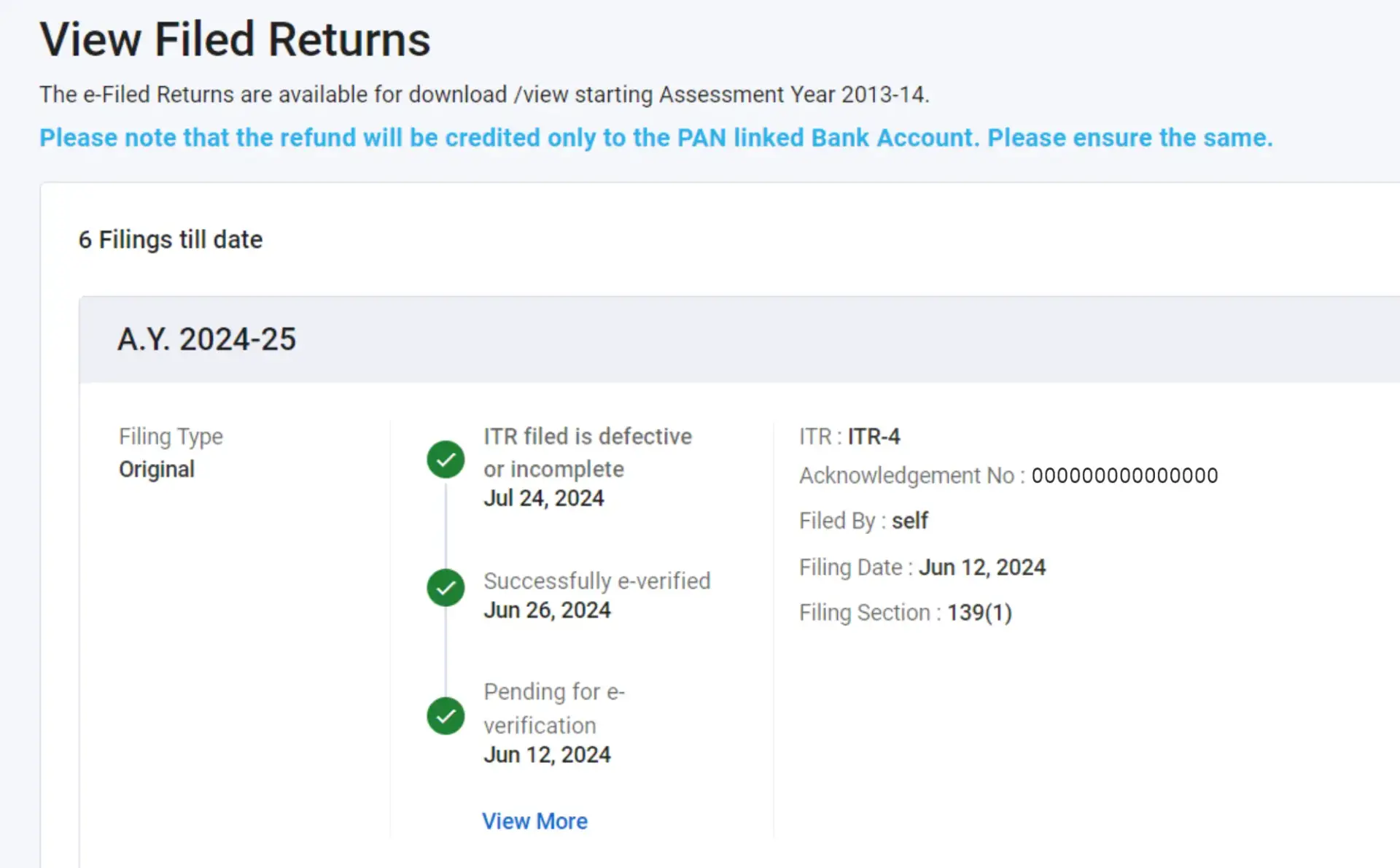
A defective-return notice can generally be viewed and responded to through the official Income Tax e-Filing portal. Follow the instructions provided against the specific notice.

01

Read and Understand the Notice

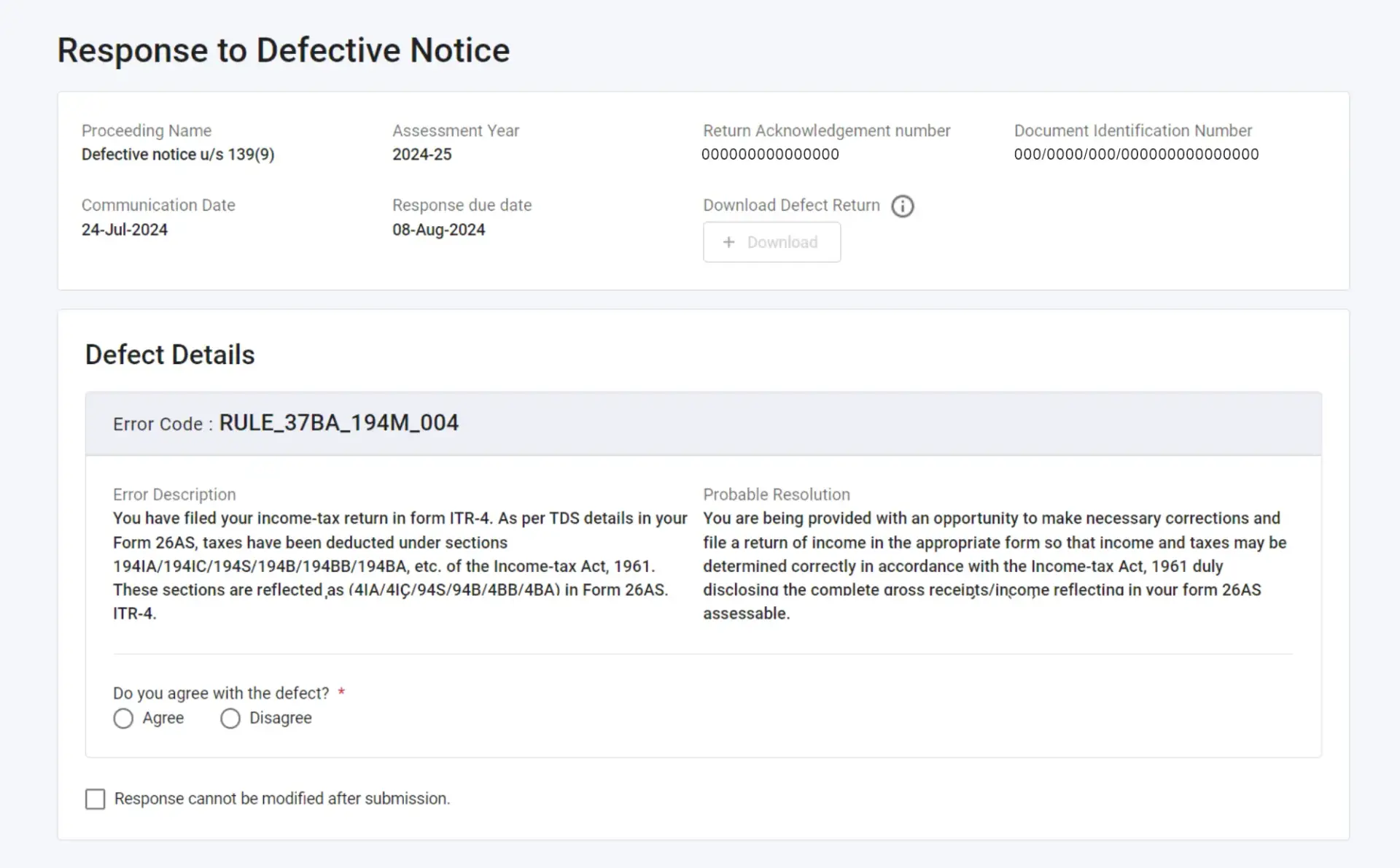
Check the notice date, Assessment Year or Tax Year, Document Identification Number (DIN), defect description and correction deadline. Identify exactly which filing requirement the Department considers incomplete.

02

Log In to the Income Tax e-Filing Portal

Visit the official Income Tax e-Filing portal and log in using your registered credentials. Make sure the notice relates to the correct taxpayer account.

03

Open the Defective-Return Notice

Go to Pending Actions → e-Proceedings → For Your Action. Select the defective-return notice and choose the option to view the notice or submit a response.

04

Agree or Disagree With the Identified Defect

Review the defect details. If the issue is correct, select the applicable Agree option and proceed with correction. If you believe the defect has been incorrectly identified, choose Disagree where available and provide a factual explanation.

05

Submit the Corrected Return Information

Correct the relevant information according to the notice. Depending on the portal and applicable filing mode, this may require completing the corrected ITR through an available online facility or uploading the corrected ITR JSON file generated using the applicable return utility.

06

Submit and Save the Confirmation

Review the final response, complete the required declaration or verification, and submit it. Retain the acknowledgement, Transaction ID or submission confirmation for future reference. Confirm that the response status is updated in the portal.

Official portal: Income Tax e-Filing Portal. The available correction options may differ according to the notice and return type. A submitted response generally cannot be edited or withdrawn, so review it carefully before submission.


Defective-Return Response vs Revised Income Tax Return

Correcting a defect under Section 139(9) (Now Section 263(7)) is different from filing a revised return under Section 139(5) (Now Section 263(5)). The appropriate procedure depends on whether you received a defective notice, discovered an error yourself, and remain eligible to revise the return.

Defective-Return Response

Used when the Department identifies a prescribed defect and issues a notice. The taxpayer responds through the notice-specific procedure and corrects the reported defect within the permitted period.

Revised Income Tax Return

Used when an eligible taxpayer discovers an omission or incorrect statement in a filed return and files a revised return within the applicable statutory window. Revision is not a substitute for responding to every defective-return notice.

If you identify an error independently, understand how to file a revised return and verify whether the statutory revision window is still open.

Another common question is can you revise a return after processing. Return processing alone does not necessarily prevent a valid revision; the applicable law, filing deadline and assessment status must be considered.

If you are eligible to file your revised ITR, remember that filing a revision and submitting a response to a Section 139(9) notice are distinct compliance actions.

Important: If the ordinary revised-return filing period has expired, do not assume you can resolve a defective notice simply by filing another regular return. Follow the notice-specific correction procedure and seek an extension where available. For Tax Year 2026–27 onwards, the revision rules and time limits under the Income-tax Act, 2025 apply. Earlier Assessment Years remain subject to their applicable old-law provisions.


Tips to Avoid a Defective Income Tax Return

Many defective-return notices can be avoided by reviewing return eligibility, mandatory schedules and tax-reporting information before submission.

Select the Correct ITR Form

Check the form's eligibility for your taxpayer category, income sources and relevant filing year.

Complete All Applicable Schedules

Fill in the mandatory income, deduction, capital-gains, business and other schedules relevant to your situation.

Reconcile Income and Tax Credits

Compare your records with AIS, TDS/TCS information, bank records and other available tax data.

Check Applicable Audit Requirements

Where an audit report must be furnished separately, ensure it is submitted within the prescribed requirements and timeline.

Review Tax Payments

Verify relevant self-assessment tax, interest and payment details. Some return types have specific payment-related reporting requirements.

Verify the Return Before Submission

Review the complete return, check personal details, complete the required e-verification and retain the acknowledgement.

Do you need to attach Form 16, bank statements and deduction proofs while filing the ITR? Generally, no. Income-tax returns are ordinarily filed without attaching supporting documents. However, taxpayers must retain relevant financial records, and separately prescribed reports may need to be furnished under the applicable law. Form 16 ( Now Form 130 ), bank statements and other records may be useful for preparing and verifying the information in the return.


Conclusion: Section 139(9) of the Income Tax Act

Section 139(9) (Now Section 263(7)) provides a statutory process for identifying and correcting defective income-tax returns. It gives taxpayers an opportunity to address prescribed filing defects before the return is treated as invalid.

Receiving a defective-return notice does not automatically mean that additional tax is payable or that the taxpayer has committed tax evasion. However, failing to respond within the permitted period can result in the return being treated as not furnished, with potentially significant tax-related consequences.

The correct approach is to read the notice, identify the reported defect, follow the prescribed response procedure, submit accurate information and retain the submission confirmation.

Key Takeaway: A defective-return notice is an opportunity to correct a filing problem. The most important steps are understanding the defect, responding within the allowed time, correcting only the relevant issues through the proper procedure, and maintaining accurate financial records for future compliance.

CA Sagar Batra - Chartered Accountant
Written & Reviewed By

CA Sagar Batra

ICAI Registered Chartered Accountant · 10+ Years of Professional Experience · 12,000+ Tax Filings

Chartered Accountant with experience in taxation, compliance and business advisory. His work covers Income Tax, GST, TDS, tax notices, business compliance and financial documentation for individuals and businesses across India.

✓ Income Tax ✓ GST ✓ TDS ✓ Tax Notices ✓ Business Compliance
✓ Content reviewed for tax accuracy, practical relevance and compliance context.