
Need Help Filing Your ITR?
Section 148A of Income Tax Act
Complete Guide to Reassessment, Time Limits, Rights, Procedure, and How to Reply
Received a notice from the Income Tax Department suggesting that some income may have escaped assessment? Understand why a reassessment show-cause notice is issued, how the procedure works, what your rights are and how to prepare a reply before the Assessing Officer decides whether reassessment should proceed.
Important: Section 148A (Now Section 281) generally provides an opportunity to respond to the information suggesting escaped income before a reassessment notice is issued, subject to statutory exceptions. Receiving a show-cause notice does not itself mean that additional tax liability has been finally determined.
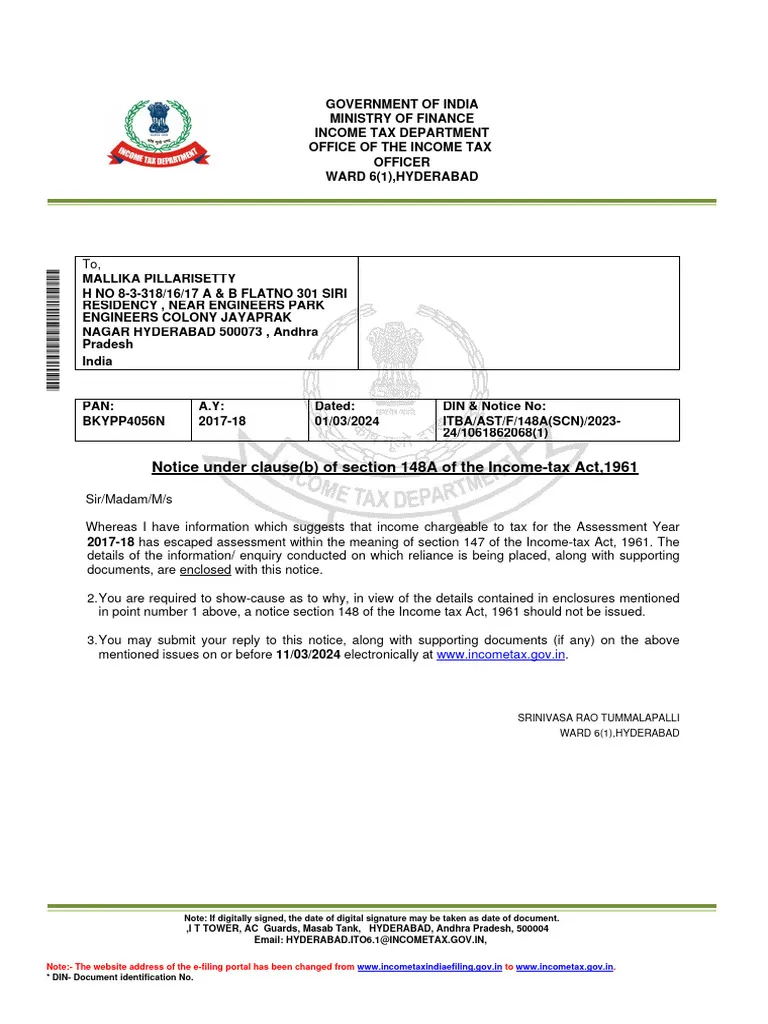
Why Is a Notice Issued Under Section 148A?
The Assessing Officer may initiate proceedings under Section 148A (Now Section 281) when information available to the Income Tax Department suggests that income chargeable to tax may have escaped assessment for a relevant year.
This does not necessarily mean that you deliberately concealed income or committed tax evasion. The Department may receive information from banks, financial institutions, property registrars, stock exchanges, mutual funds, employers and other reporting persons. It can also examine other relevant information obtained through authorised statutory processes.
Where such information raises a concern about unreported taxable income, the Assessing Officer may issue a show-cause notice asking you to explain the transaction before deciding whether reassessment should proceed. Not every Income tax Notice means that additional tax is payable.
The Department receives relevant transaction or assessment information.
Information suggests that taxable income may not have been assessed.
A show-cause notice may be issued before reassessment proceeds, subject to statutory exceptions.
12 Common Situations That May Lead to a Section 148A Enquiry
The following transactions or reporting differences may become relevant when the available information suggests escaped taxable income. None of these situations automatically proves a violation or requires a reassessment notice.
Large Cash Deposits
Substantial deposits in a bank account may lead to questions about the source of funds, particularly where the source is not clear from available records.
Significant Cash Withdrawals
Large cash withdrawals, particularly from current accounts, may be examined alongside business records and other financial information.
High-Value Fixed Deposits
Large time deposits may prompt source-of-funds questions. Separately, taxable FD interest omitted from the return may require reconciliation.
Credit Card Payments
High credit-card payments may raise a source-of-funds question when other information suggests a material income discrepancy.
Property Purchase or Sale
A property purchase may prompt questions about funding. A property sale may be relevant where taxable capital gains were not correctly reported.
Shares and Mutual Funds
Securities transactions may require review where taxable capital gains, dividends or other investment income appear to be omitted.
TDS / TCS Information Difference
Tax deducted or collected against a PAN may indicate receipts that need reconciliation with the income declared in the return.
GST and ITR Reporting Differences
Differences between GST-reported turnover and business figures in the Income Tax Return may require explanation, including applicable accounting or timing differences.
Agricultural Income Claims
Substantial agricultural income may be examined where available information raises questions about the claim's nature, source or eligibility for exemption.
High-Value Vehicle Purchases
Information about an expensive vehicle purchase may become relevant when the source of funds or associated taxable income is unclear.
Foreign Income or Assets
Information about foreign accounts, investments or income may raise questions where reporting or tax obligations apply to the taxpayer.
Third-Party Information
Relevant information may come from audits, permitted enquiries, international exchanges or other sources. A separate Section 133(6) notice can also be used to seek information under its own legal procedure.
High-Value Transactions: What Amounts Are Reportable?
The following are selected financial transaction reporting thresholds under the Income-tax Rules, 2026. They help explain how information may reach the Department. These are reporting limits, not Section 148A notice limits.
Cash Deposits in Non-Current Accounts
Aggregate deposits in one or more applicable accounts for a PAN holder during a financial year.
Current Account Cash Transactions
Aggregate cash deposits or withdrawals in the relevant current accounts during a financial year.
Fixed / Time Deposits
Aggregate qualifying time deposits, excluding renewal of an existing time deposit.
Credit Card Bill Payments
₹1 lakh or more paid in cash, or ₹10 lakh or more through other modes, in a financial year.
Immovable Property Transactions
Qualifying purchase, sale, gift or joint development agreement where the transaction amount or stamp-duty value reaches the prescribed limit.
5 Practical Examples of Possible Section 148A Issues
These examples show why a particular transaction might require explanation. They do not mean that a notice must be issued in every such case.
Shares Sold but Capital Gains Not Reported
A sells shares of a listed company but does not report the taxable capital gain in the ITR. Relevant transaction information may suggest that taxable income was omitted.
Check: Broker statement, contract notes, acquisition cost and capital-gains calculation.₹10 Lakh Cash Deposited in a Bank
B deposits ₹10 lakh in a savings account. This may be a reportable transaction, but the deposit itself does not necessarily represent taxable income. It could come from earlier savings, business receipts, a loan or another identifiable source.
Check: Bank statements, cash book, source-of-funds documents and tax records.Credit Card Bills and Reported Income
C pays credit-card bills totalling ₹4 lakh while reporting comparatively low income. This fact alone does not automatically justify reassessment. The source of payment and any additional information would need examination.
Check: Bank transfers, savings, reimbursements, loans and payment records.Property Purchased for ₹50 Lakh
D purchases property worth ₹50 lakh. Information about the purchase may become available to the Department. However, the purchase is not automatically taxable income. The buyer may have used a housing loan, previous savings or other explained funds.
Check: Sale deed, housing-loan sanction, bank trail and investment-source documents.Foreign Bank Account Not Disclosed
E maintains a foreign bank account but omits information required in the applicable tax return. Where foreign asset or income reporting obligations apply, this may require explanation and separate legal review.
Check: Residential status, account statements, foreign income and relevant disclosure requirements.A high-value transaction is not the same as undisclosed taxable income. A Section 148A notice may be issued where the Assessing Officer has information suggesting income has escaped assessment, subject to the applicable procedure and exceptions. If you receive a notice, review the information supplied, identify the relevant transaction, gather supporting evidence and submit an accurate response within the specified time. The notice is an opportunity to explain your position before a decision is made on whether reassessment should proceed.
What Exactly Is Section 148A?
Section 148A of the Income Tax Act provides a statutory procedure that generally gives taxpayers an opportunity to explain their case before the Assessing Officer issues a reassessment notice under Section 148.
When the Income Tax Department has information suggesting that taxable income may have escaped assessment, the Assessing Officer generally issues a show-cause notice under Section 148A(1), where this procedure applies.
The notice asks the taxpayer to explain why reassessment proceedings should not be initiated. It must be accompanied by information suggesting that income has escaped assessment.
After considering the available material and the taxpayer's reply, if furnished, the Assessing Officer must decide whether it is a fit case to issue a reassessment notice.
Section 148A generally gives you a chance to understand the Department's concern and present your explanation before the decision to reopen your tax assessment is made.
5 Important Procedural Safeguards
You Are Informed
A show-cause notice tells you that the Department is considering whether a reassessment notice should be issued for the relevant assessment year.
Relevant Information Is Supplied
The show-cause notice must be accompanied by the information suggesting that taxable income has escaped assessment. This does not necessarily mean every underlying document is supplied automatically.
You Get an Opportunity to Reply
You may submit explanations, supporting documents and relevant records within the response period specified in the show-cause notice.
Your Reply Must Be Considered
The Assessing Officer must consider the material on record, including the reply furnished by the taxpayer, before deciding whether reassessment should proceed.
An Order Must Be Passed
Under Section 148A(3), the Assessing Officer passes an order, with prior approval of the specified authority, deciding whether it is a fit case to issue a notice under Section 148.
Key Takeaway: Section 148A is an important procedural safeguard. It allows the taxpayer to respond to the Department's information, while requiring the Assessing Officer to consider the available material before deciding whether reassessment should proceed.
Section 148 vs 148A vs 147 – Explained Simply
Sections 147, 148 and 148A are closely connected, but each has a different legal purpose. One deals with the opportunity to respond, another with issuing a reassessment notice, and the third provides the power to reassess escaped taxable income.
(Now Section 281)
Opportunity to Explain
Section 148A provides the procedure generally followed before issuing a reassessment notice. The Assessing Officer gives the taxpayer an opportunity to explain information suggesting that taxable income may have escaped assessment.
(Now Section 280)
Notice for Reassessment
Section 148 governs the formal notice issued when the Assessing Officer proceeds with reopening the relevant assessment, subject to the applicable statutory conditions.
(Now Section 279)
Power to Reassess Income
Section 147 empowers the Assessing Officer to assess or reassess income that has escaped assessment, subject to the conditions and procedures laid down in law.
Simple way to remember: Section 148A provides an opportunity to respond before reopening. Section 148 is the formal notice requiring a return for reassessment. Section 147 provides the legal power to assess or reassess escaped income.
Is Section 148A always mandatory? Section 148A is generally the procedural safeguard before a Section 148 notice, but the law provides specific exceptions. For example, Section 148A(4) excludes certain cases involving information received under a notified statutory scheme. The new Act also specifies exceptions under Section 281(4). Therefore, the absence of a Section 148A show-cause notice does not automatically make every reassessment invalid. Validity depends on the applicable statutory provisions and facts of the case.
Who Can Issue a Section 148A Notice?
A show-cause notice under Section 148A is issued by an authorised Assessing Officer (AO) exercising jurisdiction under the applicable Income Tax Act and administrative framework. However, issuing the notice and obtaining approval for the decision to proceed with reassessment are two different steps. The law requires specified procedural safeguards before the Assessing Officer can decide whether to issue a notice under Section 148.
1. Who Has the Authority to Issue the Notice?
Section 148A authorises the Assessing Officer to issue a show-cause notice when information suggests that income chargeable to tax may have escaped assessment. The officer must act within the powers and jurisdiction assigned under the applicable law.
Jurisdiction should not be understood as being limited in every case to a single local officer linked to your PAN. Depending on the applicable statutory scheme, jurisdiction may involve authorised reassessment or faceless proceedings.
2. Who Is the Specified Approving Authority?
Under Section 151 (Now Section 284) , the specified authority under the presently applicable reassessment framework may be one of the following officers:
3. How Does the Approval Process Work?
AO Issues the Show-Cause Notice
Where the Section 148A procedure applies, the Assessing Officer issues a notice asking the taxpayer to explain why reassessment proceedings should be initiated. The notice must be accompanied by the relevant information suggesting escaped taxable income.
AO Considers the Taxpayer's Reply
The taxpayer may submit an explanation and supporting documents within the period specified in the notice. The Assessing Officer must consider the material available on record, including the reply, if furnished.
Prior Approval Before the Final Decision
Under Section 148A(3), the Assessing Officer must obtain prior approval from the specified authority before passing the order deciding whether it is a fit case to issue a reassessment notice under Section 148.
How Can You Verify a Section 148A Notice?
Use the Income Tax e-Filing portal's Authenticate Notice / Order service to verify the communication using its DIN or other supported details.
Confirm the taxpayer details, relevant year, issuing authority, notice date and section mentioned in the communication.
If an order under Section 148A(3) has been passed, check its reasoning and any available approval details. Seek professional review if jurisdiction or approval appears incorrect.
Key Takeaway: A Section 148A notice must come from an Assessing Officer authorised under the applicable law. The relevant approval requirement applies at the statutory decision stage, and the authority giving approval must be legally competent. These requirements provide oversight of the reassessment process, but approval does not automatically establish that escaped income exists. Taxpayers should verify the notice, read the information supplied and respond within the specified time.
Detailed Step-by-Step Procedure Under Section 148A
Section 148A (Now Section 281) provides the procedure generally followed before the Income Tax Department issues a notice to reopen an assessment. It gives the taxpayer an opportunity to explain information suggesting that taxable income may have escaped assessment, before the Assessing Officer (AO) decides whether reassessment should proceed. The following seven steps explain the usual process, subject to applicable statutory exceptions.
Information Reaches the Assessing Officer
The process begins when the Assessing Officer receives information suggesting that income chargeable to tax may have escaped assessment for a particular year.
For example, information may show cash deposits of ₹40 lakh, property transactions, securities sales or receipts reported by third parties.
AO Examines the Available Information
The Assessing Officer considers whether the information suggests that taxable income was not assessed or was assessed incorrectly.
Relevant details may include the taxpayer's filed ITR, available transaction data and information indicating whether the amount was already reported or explained.
A difference between transaction information and the ITR is a starting point for examination, not automatic proof of escaped income.
Further Enquiry, Where Necessary
Depending on the information and the powers available under law, the Assessing Officer may examine additional records to understand the transaction or reported income.
Relevant information may include:
- Bank statements and deposit records
- Filed ITR and supporting schedules
- GST returns and turnover information
- Third-party transaction information
Show-Cause Notice Is Issued
Where the statutory procedure applies, the Assessing Officer issues a show-cause notice under Section 148A(1), asking why a reassessment notice under Section 148 should not be issued.
The notice must be accompanied by information suggesting that income chargeable to tax has escaped assessment.
- Relevant assessment year
- Information or transaction in question
- Basis of the proposed reopening
- Deadline for submitting a reply
You Submit Your Explanation and Evidence
You can submit a response under Section 148A(2) within the time specified in the show-cause notice.
A useful response should explain the actual facts and directly address the information relied upon by the Department.
- Clear written explanation
- Bank or financial statements
- Income and transaction reconciliation
- Relevant supporting documents
Assessing Officer Passes an Order
After examining the available material and considering the taxpayer's reply, if furnished, the Assessing Officer passes an order under Section 148A(3).
The order requires prior approval of the specified authority and determines whether it is a fit case to issue a reassessment notice.
No Section 148 reassessment notice is issued on the basis of that decision.
The Assessing Officer may proceed to issue the formal notice, subject to applicable law.
Section 148 Notice Is Issued, If Applicable
If the case is approved for reassessment and the statutory requirements are satisfied, the Assessing Officer may issue a notice under Section 148 (Now Section 280).
This formal notice generally requires the taxpayer to furnish a return for the relevant year within the period specified in the notice.
The subsequent assessment or reassessment proceeds under the applicable legal framework. The taxpayer may need to provide further explanations or supporting records during those proceedings.
Why Do Some Older Notices Mention Section 148A(b) or 148A(d)?
Under the earlier procedure, the show-cause notice was referred to under Section 148A(b) and the decision order under Section 148A(d). Following the amendment effective from 1 September 2024, the corresponding provisions are Section 148A(1) and Section 148A(3). For 2026 and subsequent years, always identify the Assessment Year or Tax Year and the law applicable to the specific proceedings.
Is This the Same as Normal ITR Processing?
No. Reassessment proceedings deal with information suggesting that income may have escaped assessment. This is different from routine intimation under Section 143(1), which communicates the result of CPC return processing. A routine processing intimation does not automatically prevent a legally valid reassessment proceeding from being initiated later.
Information → Initial Review → Further Verification, If Needed → Show-Cause Notice → Taxpayer's Reply → AO's Order → Reassessment Notice, If Applicable. Section 148A provides a procedure for examining whether reassessment should be initiated, generally giving the taxpayer an opportunity to explain the information suggesting escaped taxable income. The notice and decision requirements are subject to statutory exceptions. The most important step for a taxpayer is to examine the notice carefully, reconcile the transactions and submit an accurate, evidence-supported response within the specified time.
Time Limits Under Section 148A: Finance Act 2024 & 2026 Update
The time limit for issuing an income-tax reassessment notice depends on the relevant Assessment Year or Tax Year, the type of notice, and the amount of income believed to have escaped assessment. The Finance (No. 2) Act, 2024 reduced the extended reassessment period under the Income-tax Act, 1961. However, the Income-tax Act, 2025 introduced a different limitation framework for Tax Year 2026–27 onwards.
Reassessment Time Limits for Tax Year 2026–27 Onwards
Under Section 149 (Now Section 282), separate time limits apply to the show-cause notice under Section 148A (Now Section 281) and the formal reassessment notice under Section 148 (Now Section 280).
| Income That May Have Escaped Assessment | Show-Cause Notice Section 148A | Reassessment Notice Section 148 |
|---|---|---|
| Below ₹50 Lakh General time limit | 4 Years From the end of the relevant Tax Year | 4 Years 3 Months From the end of the relevant Tax Year |
| ₹50 Lakh or More Extended time limit, subject to statutory conditions | 6 Years From the end of the relevant Tax Year | 6 Years 3 Months From the end of the relevant Tax Year |
Suppose the relevant Tax Year is 2026–27, ending on 31 March 2027. If the suspected escaped income is below ₹50 lakh, the ordinary last date for issuing a show-cause notice would be 31 March 2031, while the corresponding reassessment notice limit would be 30 June 2031. These dates assume no applicable exception, exclusion or special limitation provision.
The Clock Starts From the Tax Year
The current notice-issuance limits are generally measured from the end of the relevant Tax Year, not from the date of the bank transaction or ITR filing.
₹50 Lakh Means Escaped Income
The higher threshold concerns income chargeable to tax that escaped assessment. A bank deposit or property purchase of ₹50 lakh does not automatically meet this condition.
First-Year Restriction
Under Section 282(3), the relevant notices cannot be issued within one year from the end of the Tax Year.
What Changed Under Finance Act 2024?
For earlier Assessment Years governed by the Income-tax Act, 1961, the amended Section 149 prescribed a 3-year general limit and a 5-year extended limit for issuing a Section 148A show-cause notice. For the subsequent Section 148 reassessment notice, those limits were 3 years 3 months and 5 years 3 months, respectively.
The Finance (No. 2) Act, 2024 reduced the earlier extended reopening window, which had allowed notices in certain cases up to 10 years after the end of the relevant Assessment Year. The old 3-year/5-year limits and the new 4-year/6-year limits should not be mixed.
Earlier Assessment Years, including AY 2026–27, continue to be governed by the applicable provisions of the Income-tax Act, 1961. Fresh reassessment proceedings for those years may still be initiated after 1 April 2026, subject to the old Act's applicable conditions and limits.
For Tax Year 2026–27 onwards: 4 or 6 years for a show-cause notice, and 4 years 3 months or 6 years 3 months for a reassessment notice. The ₹50 lakh threshold relates to suspected escaped taxable income, not simply the value of a transaction. For earlier Assessment Years, the Finance Act 2024 framework may continue to apply under the Income-tax Act, 1961. Always verify the governing law, relevant year, notice date and statutory conditions before concluding that a reassessment notice is within or beyond time.
How to Reply to a Notice Under Section 148A
If you receive a show-cause notice under Section 148A (Now Section 281) , the first step is to carefully read the information supplied by the Income Tax Department. Your response should address the actual transactions, identify the source of funds and provide supporting evidence wherever required.
The best approach is a clear, point-wise reply supported by genuine financial records. A well-organised response helps the Assessing Officer understand your explanation before deciding whether to proceed with reassessment.
Suppose Mr. Mehra purchases a flat worth ₹1.25 crore while reporting annual salary income of ₹20 lakh. The Department has information about the property purchase and seeks clarification regarding the transaction and its funding. The difference between property value and annual salary does not automatically mean that undisclosed taxable income exists. The property could have been purchased using a housing loan, accumulated savings, documented asset-sale proceeds or other legitimate funds.
1. What Details and Documents May the Notice Ask For?
The exact information requested depends on the notice. In a property-purchase enquiry, the Assessing Officer may ask for the following details.
Property Seller Details
Name, address and PAN of the seller, where available and relevant, along with the identity details requested in the notice.
Sale Deed or Allotment Letter
Registered sale deed, builder allotment letter, agreement to sell and other relevant property documents.
Complete Property Information
Flat address, property description, purchase consideration, registration details and relevant transaction dates.
Property Payment Details
Date-wise payment information, bank statements, payment receipts and evidence of transfers made to the seller or builder.
Source of Funds
Documents explaining the sources used to finance the property, including loans, savings, investments or other receipts.
Supporting Tax Records
Relevant ITR, income records, applicable property-TDS records, and other documents requested for the transaction.
2. How to Prepare a Point-Wise Reply
Organise your response in the same sequence as the questions raised in the notice. Avoid giving only a general statement that the purchase is genuine. Explain the facts and support important figures with documents.
Verify the Notice and Identify the Transaction
Check the PAN, relevant Assessment Year or Tax Year, notice date, Document Identification Number (DIN) and deadline for response.
Confirm that the property, transaction amount and period mentioned in the notice relate to your records.
Provide Seller and Property Details
State the seller's name, address and PAN where relevant, along with the complete property address and acquisition details.
Attach the registered sale deed, agreement, allotment letter and other documents requested in the notice.
Explain Every Relevant Property Payment
Prepare a date-wise reconciliation of the property consideration and the amounts paid through your bank accounts or loan disbursement.
Match each payment with the sale deed, allotment or payment schedule. Highlight relevant entries in the bank statements and attach payment receipts.
If a difference exists, explain the actual reason. For example, some amounts may relate to registration costs, taxes, maintenance or other separately documented charges.
A payment difference does not automatically result in a penalty. Any separate tax consequence depends on the applicable law and facts.
Explain the Actual Source of Funds
This is often the most important part of a property-related reply.
Explain how the purchase was financed and provide a supporting document trail. If multiple sources were used, reconcile them with the total amount paid.
The explanation should distinguish between current income, previously accumulated funds and borrowed money.
Submit Your Conclusion and Supporting Documents
Finish with a clear summary explaining how the total property consideration was funded.
Refer to the relevant attachments, clarify any discrepancies, and request the Assessing Officer to consider your explanation while deciding whether reassessment is warranted.
Submit the response within the time specified in the notice, and retain the submission acknowledgement.
3. What Can Be Shown as the Source of Property Funds?
For a purchase like Mr. Mehra's, different funding sources may be relevant depending on the actual facts. Each source should be explained with appropriate supporting records.
Loan sanction letter, loan account statement and bank disbursement details showing payment towards the property.
Historical bank statements, accumulated salary savings and relevant income records supporting the available funds.
Original FD details, maturity statement, bank credit and evidence connecting the proceeds with the property payment.
Sale documents, broker statements, capital-gains records and evidence of the sale proceeds received in the bank.
Gift deed or relevant declaration, identity of the provider and banking records. Tax treatment depends on the relationship and applicable legal conditions.
Loan agreement or confirmation, lender identity, relevant financial capacity and documented banking trail, subject to cash-transaction rules.
Important: Cash Deposits and Cash Loans
A cash deposit of more than ₹5 lakh is not automatically unexplainable. Its source must be supported by the actual facts and available evidence, such as cash books, earlier withdrawals, past savings or other legitimate records.
However, receiving a cash loan is a separate compliance issue. Under Section 269SS (Now Section 185) , acceptance of loans, deposits and specified sums of ₹20,000 or more is generally subject to prescribed banking-mode restrictions. The threshold can also apply by considering certain earlier unpaid amounts from the same person. Statutory exceptions exist.
Do not create an incorrect loan explanation or fabricate documents. If the money was actually received in cash, disclose the true facts and examine the applicable tax and cash-transaction provisions before submitting your response.
4. Example of a Written Reply for Property Purchase
The following is an illustrative structure only. Replace the bracketed details with the taxpayer's actual facts and supporting documents.
Subject: Reply to Show-Cause Notice Under Section 148A Regarding Purchase of Immovable Property
With reference to the notice bearing DIN [Notice DIN], I submit that the flat situated at [Property Address] was purchased for a total consideration of ₹1,25,00,000.
The property was acquired from [Seller Name]. A copy of the registered sale deed or relevant allotment document is enclosed for reference.
The purchase consideration was financed through [Housing Loan], [Accumulated Savings] and [Other Actual Sources], as applicable. The respective supporting documents and a date-wise payment reconciliation are enclosed.
I request that the explanation and accompanying evidence be considered while determining whether any income chargeable to tax has escaped assessment in relation to this transaction.
5. How to Submit Your Section 148A Reply Online
The Income Tax Department's e-Proceedings facility allows taxpayers or authorised representatives to view notices and submit responses with supporting attachments.
Login → Pending Actions → e-Proceedings → For Your Action → Select Notice → Submit Response
Open Official Income Tax e-Filing Portal →Read the response instructions, upload the relevant documents in the supported format, complete the submission process and save the acknowledgement. Verify the deadline and the available submission window shown for your proceeding.
6. What Happens After You Submit the Reply?
After considering the information on record and your reply, if furnished, the Assessing Officer passes an order deciding whether it is a fit case to issue a reassessment notice. Under the applicable procedure, the decision requires the prescribed prior approval.
Not a Fit Case for Reassessment
The Assessing Officer concludes that issuing a reassessment notice is not justified on the material considered. A Section 148 notice is not issued on the basis of that decision.
Reassessment May Proceed
If the Assessing Officer concludes that the case is fit for reassessment, a notice under Section 148 (Now Section 280) may be issued, subject to the applicable conditions. This is not itself a final tax-demand determination.
Read the Notice → Identify the Transaction → Prepare a Point-Wise Explanation → Prove the Source of Funds → Upload Evidence → Save Acknowledgement. For a property-purchase enquiry, your response should explain the seller details, property documents, payments and genuine sources of funds. A property costing more than your annual salary does not automatically establish undisclosed taxable income. The important requirement is to provide an accurate explanation supported by relevant records and submit it within the applicable response period.
What Happens If You Do Not Reply to a Section 148A Notice?
Ignoring a show-cause notice under Section 148A (Now Section 281) can affect your ability to explain the information relied upon by the Income Tax Department before reassessment. However, failure to reply does not automatically establish tax evasion or create a fixed monetary penalty. The consequences depend on the statutory procedure and any subsequent notices or assessment proceedings.
Is There a Direct Penalty for Not Replying?
Section 148A does not prescribe a separate fixed amount-wise penalty merely because the taxpayer fails to submit a reply. But the Assessing Officer may still decide whether reassessment should proceed based on the available material, even when no reply is furnished.
4 Possible Consequences of Not Replying
The consequences usually arise through different stages of the reassessment process. They should not be treated as automatic penalties for the original show-cause notice.
AO May Decide Without Your Explanation
Under Section 148A(3), the Assessing Officer considers the material available on record and the taxpayer's reply, if furnished. If you do not respond, the officer may pass the required order without having your explanation or supporting documents before them.
Reassessment Notice May Be Issued
If the Assessing Officer concludes that the case is fit for reassessment and the legal conditions are satisfied, a notice under Section 148 (Now Section 280) may be issued. This does not itself establish the final amount of tax payable.
Further Information May Be Required
During subsequent assessment proceedings, the Department may seek relevant records or explanations through a notice under Section 142(1) (Now Section 268(1)). Any such request must remain within the powers and requirements of the applicable law.
Best-Judgment Assessment May Follow
If the taxpayer later fails to furnish a required return or comply with prescribed assessment notices, the conditions for Section 144 (Now Section 271) may become relevant. Under this procedure, the Assessing Officer determines income on the basis of the available material and applicable safeguards.
Under Section 272A(1)(d) (Now Section 465(1)(d)), failure to comply with certain assessment notices, including a notice under Section 142(1), can attract a penalty of ₹10,000 for each default, subject to the applicable law and penalty procedure.
This penalty is not imposed automatically for failing to reply to a Section 148A show-cause notice. It relates to separately specified statutory defaults. A taxpayer's opportunity to be heard and other relevant safeguards must also be considered.
Practical Example: Ignoring a Notice About Bank Deposits
Suppose Mr. Sharma receives a Section 148A show-cause notice because the Department has information concerning ₹40 lakh deposited in his bank account.
Mr. Sharma can explain that the deposits came from documented business collections, transfers from his other accounts or maturity of earlier fixed deposits, if these are the actual sources.
If he does not reply, the Assessing Officer may consider the information available and decide whether to issue a reassessment notice. The ₹40 lakh deposit does not automatically become ₹40 lakh of taxable undisclosed income.
A timely explanation supported by bank statements, books of account and relevant documents gives the Department an opportunity to consider the taxpayer's position before making that decision.
What Should You Do Instead of Ignoring the Notice?
Even where the Department's information is incomplete or incorrect, it is better to submit a factual response through the applicable official procedure.
Read the Notice
Check the relevant year, information supplied, amount in question and response deadline.
Prepare Your Explanation
Address the Department's specific concerns and attach genuine supporting documents and reconciliations.
Submit and Save
Respond through the official e-Filing portal within the specified time and preserve the acknowledgement.
No automatic penalty for silence under Section 148A, but ignoring the notice can still have significant procedural consequences. The Assessing Officer may decide whether to proceed with reassessment using the available material, and later statutory notices may require additional responses and supporting documents. A timely, accurate and evidence-supported reply helps ensure your explanation is considered before the reassessment decision. Responding does not guarantee that proceedings will be dropped, but it allows you to present your position at the relevant stage.
Who Can Reply to a Section 148A Notice?
A reply to a show-cause notice under Section 148A (Now Section 281) can generally be submitted by the taxpayer or by an appropriately authorised representative, including a Chartered Accountant (CA). Hiring a CA is not compulsory for every notice. However, professional assistance may be useful where the case involves complex transactions, disputed income, multiple assessment years or questions about reassessment procedure.
The best approach depends on the actual income tax notice, the information relied upon by the Department and the supporting evidence available to you.
Two Ways to Respond to a Section 148A Notice
Taxpayer Can Submit the Reply
You can respond directly through your own Income Tax e-Filing account where the notice is available for electronic response.
- Read the notice and understand the transactions or issues raised.
- Prepare a clear, point-wise explanation addressing each question.
- Upload relevant bank statements, tax records and supporting documents.
- Submit the response within the deadline specified in the notice.
- Download or save the submission acknowledgement for future reference.
When the issue is straightforward, the source of the transaction is clear and you have sufficient documents to explain the facts accurately.
A Chartered Accountant Can Assist
A CA can help analyse the notice, examine the applicable provisions and prepare an evidence-supported response to the Department.
- Review the notice, relevant year, statutory provisions and deadlines.
- Reconcile the ITR with bank transactions, AIS, TDS/TCS records and financial statements.
- Examine income-escapement concerns and the available supporting evidence.
- Prepare a structured reply explaining the taxpayer's position.
- Submit or assist with the response through the permitted representation procedure.
When a notice concerns large financial transactions, unexplained credits, business discrepancies, complex property transactions or legal questions about reassessment.
How Can a CA Reply on Your Behalf?
The Income Tax Department's e-Proceedings service supports authorised representatives. Where this facility is available for your notice, you can authorise an eligible representative rather than sharing your own account credentials.
Open the Notice
Log in to the official e-Filing portal. Navigate to Pending Actions → e-Proceedings and select the relevant notice.
Authorise the Representative
Use the available Add / View Authorized Representative option and complete the required authorisation steps for that proceeding.
Submit the Response
Once authorised and able to access the proceeding, the representative can submit the appropriate response and supporting documents within the available response period.
Login → Pending Actions → e-Proceedings → Select Notice → Add / View Authorized Representative
Portal options may vary according to the notice type and proceeding. The Income Tax Department permits one active authorised representative at a time for a proceeding.
You can reply to a Section 148A notice yourself or seek assistance from a Chartered Accountant. A CA is not mandatory in every case, but professional review can be useful where the transactions, tax calculations or legal issues require detailed examination. Whether the reply is submitted personally or through an authorised representative, it should be accurate, supported by relevant evidence and submitted within the applicable deadline.
How to Reply to Section 148A Notice Online
You can respond to a show-cause notice under Section 148A (Now Section 281) through the official Income Tax e-Filing portal, where the notice is available under e-Proceedings. The response should explain the transactions or information mentioned in the notice and include relevant supporting documents.
Before submitting, check the notice date, relevant Assessment Year or Tax Year, Document Identification Number (DIN), information supplied by the Department and the deadline for response.
Login → Pending Actions → e-Proceedings → For Your Action → View Notice
Log In to the Income Tax Portal
Visit the official e-Filing portal and sign in using your registered user ID and password.
Make sure you are accessing the correct taxpayer account or authorised representative account.
Open the e-Proceedings Section
Go to Pending Actions → e-Proceedings → For Your Action and locate the relevant notice.
Open or download the notice and review its contents before preparing the response.
Click Submit Response
Select Submit Response against the relevant notice.
Read the available instructions and choose the appropriate response type, such as Full Response or Partial Response, where offered.
Prepare a clear point-wise explanation addressing the information relied upon by the Assessing Officer.
Select Document Categories and Upload Evidence
Use the available attachment categories to upload documents that support your explanation.
Select the document category matching each attachment. Use the available "Others" category where appropriate.
Review, Submit and Save the Acknowledgement
Verify the written reply and attachments, complete the applicable declaration or verification steps, and submit the response.
After successful submission, save the Transaction ID, acknowledgement number and response confirmation for future reference.
What If You Cannot Prepare All Documents Before the Deadline?
If the response window is still open but you need more time to collect records, the portal may provide options for a partial submission or an adjournment request. Choose the option that matches your situation.
Submit a Partial Response
Where permitted, choose Partial Response to submit the explanation and supporting documents currently available.
Provide the remaining records through a further submission while the proceeding remains open. Do not treat a partial response as an automatic extension of the original deadline.
Request More Time
If available, use Seek/View Adjournment to request additional time.
State the reason, specify the additional time required and attach supporting information where appropriate. Extension is not automatic; check whether the request has been accepted.
When Is the Section 148A Procedure Not Required?
Section 148A generally provides an opportunity to respond before a reassessment notice under Section 148 (Now Section 280) is issued. However, Section 148A(4) (Now Section 281(4)) contains specific exceptions. For Tax Year 2026–27 onwards, the Income-tax Act, 2025 identifies the following circumstances.
Information Under a Notified Scheme
The AO has received information under the notified scheme for collection of information under Section 260 of the new Act.
Directions From the Approving Panel
The AO receives directions issued by the Approving Panel under Section 274(6) concerning an impermissible avoidance arrangement.
Findings or Directions in Specified Orders
The AO receives findings or directions in specified appellate, Tribunal or court orders covered by Section 281(4)(c).
Login → Open e-Proceedings → Select the Notice → Prepare Your Reply → Upload Documents → Submit and Save. Respond within the deadline, attach relevant evidence and check the submission acknowledgement. If more time is needed, use the available partial-response or adjournment facility without assuming an extension has been granted. The Section 148A procedure is generally required before reassessment, but the applicable Income Tax Act provides specified exceptions.
11. Rights of Taxpayers Under Section 148A
Section 148A (Now Section 281) provides important procedural safeguards before an income-tax reassessment notice is issued. These safeguards generally allow you to understand the Department's concern, submit your explanation and have your response considered before the Assessing Officer decides whether reassessment should proceed.
Right to Know the Information
The show-cause notice must be accompanied by information suggesting that taxable income may have escaped assessment. You should be able to understand the allegation and identify the transaction or issue being examined. This does not automatically guarantee copies of every underlying document.
Opportunity to Submit a Reply
You may submit a written response, factual explanation and relevant supporting documents within the period specified in the notice. Your response should address the information relied upon by the Department.
Opportunity to Request More Time
If additional documents are needed, you may request an adjournment or additional time through the available e-Proceedings facility. The request should explain the reason and the time required. Approval is not automatic.
Opportunity of Being Heard
The statutory show-cause procedure gives the taxpayer an opportunity to present their position. This may be exercised through a written reply. A personal or video hearing is not automatically guaranteed in every case; the applicable procedure and available facilities must be checked.
Right to Pursue an Eligible Appeal
If reassessment ultimately results in an appealable assessment order, you may pursue the appropriate statutory appeal within the applicable deadline. The preliminary Section 148A order should not be confused with a final appealable assessment order.
Right to Challenge Unlawful Reopening
Where there is a serious jurisdictional or procedural defect, a legal challenge may be available, depending on the facts. Grounds may involve limitation, mandatory approval, relevant information or denial of an effective opportunity to respond. Judicial remedies are case-specific.
12. Common Triggers for Section 148A Notices
The Income Tax Department receives financial information from various reporting entities and statutory sources. Certain transactions may require examination where the available information suggests that income chargeable to tax may have escaped assessment. However, the transaction itself does not automatically establish escaped income.
Large Cash Deposits
Substantial bank deposits whose nature or source requires reconciliation.
Property Transactions
Purchase or sale information suggesting unexplained funding or unreported taxable gains.
Cryptocurrency Trading
Virtual digital asset transactions where taxable income may have been omitted.
Share Trading
Securities transactions involving potentially unreported taxable gains or income.
GST Reporting Differences
Material differences between business turnover, GST returns and income-tax records.
Foreign Income or Assets
Foreign financial information potentially relevant to taxable income or disclosure obligations.
TDS / TCS Information
Reported receipts or transactions suggesting income not properly reflected in the return.
High Credit Card Spending
Significant payments that, together with other information, may raise source-of-funds questions.
13. What Happens If You Ignore a Section 148A Notice?
Ignoring a Section 148A notice can affect your opportunity to explain the Department's information before a reassessment decision. However, failure to reply does not automatically result in additional tax, a fixed penalty, or prosecution. The consequences depend on what happens in the subsequent legal proceedings.
Decision Without Your Reply
The Assessing Officer may decide whether reassessment should proceed using the available material if no reply is furnished. An order may conclude that issuing a formal reassessment notice is justified.
Reassessment Proceedings
Where the applicable conditions are satisfied, a notice under Section 148 (Now Section 280) may be issued. The taxpayer may then need to furnish a return and provide further explanations or records.
Tax and Other Consequences
A later reassessment may result in additional tax and applicable interest. Separate penalties or prosecution may arise only when their statutory conditions are satisfied. They are not automatic consequences of missing the show-cause reply.
14. How to Draft a Strong Section 148A Reply
A strong reply should be clear, factual, point-wise and supported by relevant documents. The purpose is not simply to deny the allegation. Your explanation should demonstrate why the information relied upon by the Department does not establish escaped taxable income, where that is your position, or accurately explain any discrepancy identified.
Legal Objections, If Applicable
Raise genuine objections relating to limitation, jurisdiction, procedure or statutory requirements, where supported by the facts.
Factual Explanation
Describe the transaction, relevant dates, amounts, parties involved and the actual nature of the receipt or payment.
Documentary Evidence
Attach relevant agreements, confirmations, sale deeds, loan documents or transaction statements.
Accounting Records
Provide the relevant ledger, cash book, balance-sheet extracts or reconciliations where applicable.
Bank Statements
Highlight the relevant credits and debits, explain the source of funds and connect them to supporting documents.
ITR Reconciliation
Compare the transaction with the filed return, applicable income schedules and tax-reporting records.
Suggested Structure for Your Reply
Opening: Refer to the notice number, DIN, relevant year and date. Identify the issues mentioned in the show-cause notice.
Point-wise response: Answer each allegation or information item separately, using correct figures and supporting evidence.
Reconciliation: Explain the difference between the Department's information and your financial or tax records.
Conclusion: State the factual and legal basis of your position and request that the explanation and documents be considered before the reassessment decision.
15. Section 148A Notice Examples
The following hypothetical examples show how a taxpayer may explain a transaction mentioned in a notice. The final decision depends on the records and legal conditions. A well-supported reply may help, but closure is never guaranteed.
₹30 Lakh Bank Deposit
Department's concern: The Assessing Officer has information showing deposits totalling ₹30 lakh in the taxpayer's bank account.
Taxpayer's explanation: Suppose the deposits comprise ₹18 lakh transferred from another account owned by the taxpayer and ₹12 lakh received as a documented bank loan.
Supporting evidence: Statements of both accounts, loan sanction letter, disbursement details and transaction reconciliation.
Possible result: If the evidence satisfactorily explains the deposits and does not suggest escaped taxable income, the AO may conclude that issuing a reassessment notice is not justified.
₹2 Crore Property Purchase
Department's concern: Information shows a property purchase for ₹2 crore, while the taxpayer reported much lower annual income.
Taxpayer's explanation: Suppose the purchase was funded by a ₹1.20 crore housing loan and ₹80 lakh received from the documented sale of an earlier property.
Supporting evidence: Loan sanction and disbursement, old property's sale deed, bank statements, capital-gains computation and the new property's purchase documents.
Possible result: The documents may establish the purchase's funding sources. The AO must still consider whether any related taxable gain or other income escaped assessment.
16. Why Courts Examine Section 148A Procedures
Section 148A reflects the legal principle that a taxpayer should generally be given an opportunity to respond before a reassessment notice is issued, subject to statutory exceptions.
Courts examine whether the Assessing Officer has complied with the applicable legal procedure. A dispute may involve the information supplied, whether an effective opportunity was provided, consideration of the taxpayer's reply, mandatory approval or the statutory time limit.
In appropriate cases, courts may set aside a defective notice or order, or direct the authority to reconsider the matter after following the proper procedure. However, not every procedural objection automatically invalidates reassessment.
The taxpayer should receive the opportunity required under the applicable statutory procedure.
The authority must consider the taxpayer's response, if furnished, when making the relevant decision.
The decision must address whether the legal requirements for issuing a reassessment notice are satisfied.
The show-cause procedure may be dispensed with only where an applicable legal exception permits it.
17. Conclusion
Section 148A is an important procedural safeguard in India's income-tax reassessment framework. It generally provides an opportunity for the taxpayer to understand the information suggesting escaped taxable income and submit an explanation before reassessment proceedings move forward.
The procedure also requires the Assessing Officer to consider the available material and the taxpayer's reply, if furnished, before making the relevant decision, subject to applicable exceptions.
If you receive a Section 148A notice, do not assume that the Department has already established tax evasion. At the same time, do not ignore the communication simply because you believe the transaction is genuine. The right response is to verify the facts, explain the transactions and submit genuine evidence within the available time.
Understand the Notice
Read the relevant year, information supplied, statutory references and response deadline.
Verify the Records
Compare the transaction with your ITR, bank statements, financial records and supporting documents.
Submit an Accurate Reply
Provide a clear point-wise explanation and retain the official submission acknowledgement.
A Section 148A notice is an opportunity to explain, not a final tax-demand order. Reassessment is governed by specific legal requirements, applicable time limits and procedural safeguards. A properly prepared response can help ensure that the Department considers your explanation and supporting evidence before determining whether reassessment should proceed. Understanding your rights, acting before the deadline and maintaining accurate records are essential for handling income-tax notices effectively.
Frequently Asked Questions About Section 148A
Find answers to common questions about Section 148A income-tax notices, reassessment procedures, time limits, taxpayer rights and how to submit a reply under the rules applicable in 2026 and upcoming tax years.
01 What is Section 148A of the Income Tax Act?
Section 148A (Now Section 281) provides a procedure generally followed before the Income Tax Department issues a reassessment notice.
Where the procedure applies, the Assessing Officer gives the taxpayer an opportunity to explain information suggesting that income chargeable to tax may have escaped assessment.
After considering the available material and the taxpayer's reply, if furnished, the officer decides whether issuing a reassessment notice is justified, subject to the applicable statutory rules.
02 What is the difference between Sections 147, 148 and 148A?
Section 147 (Now Section 279) gives the Assessing Officer the power to assess or reassess income that has escaped assessment.
Section 148 (Now Section 280) governs the formal notice requiring the taxpayer to furnish a return for reassessment.
Section 148A (Now Section 281) deals with the procedure generally followed before issuing that notice.
03 Why does the Income Tax Department issue a Section 148A notice?
A notice may be issued when the Assessing Officer has information suggesting that taxable income may have escaped assessment.
Relevant information may concern large bank deposits, property transactions, securities trading, virtual digital assets, foreign income or differences between reported financial information and income-tax records.
A transaction appearing in a financial report does not automatically establish undisclosed income. Its nature, source and tax treatment must be considered.
04 Who can issue a Section 148A notice?
A Section 148A notice is issued by an Assessing Officer authorised under the applicable income-tax law and jurisdictional framework.
The officer must follow the prescribed statutory procedure. The decision on whether it is a fit case for reassessment requires prior approval from the specified authority under the relevant provisions.
Taxpayers should verify the notice's DIN, PAN, relevant year and issuing authority through the official Income Tax e-Filing portal.
05 How can I reply to a Section 148A notice online?
You can generally respond through the Income Tax Department's e-Proceedings facility.
- Log in to the official Income Tax e-Filing portal.
- Open Pending Actions → e-Proceedings.
- Find the relevant notice under For Your Action.
- Select Submit Response and prepare your point-wise explanation.
- Upload relevant supporting documents in the permitted formats.
- Submit the response and save the acknowledgement.
The exact portal options may vary according to the notice and proceeding.
06 How many days do I get to reply to a Section 148A notice?
The response period is specified in the show-cause notice. Check the exact deadline displayed in your communication and on the e-Filing portal.
If you need additional time to obtain documents, you may request an adjournment or extension through the available procedure.
An extension is not automatic. Do not assume the original deadline has changed unless the request is accepted.
07 What documents are required to reply to a Section 148A notice?
The documents depend on the issue mentioned in the notice. Common supporting records include:
- Relevant bank statements and transaction details.
- Filed ITR and income computations.
- Property sale deeds or allotment letters.
- Loan sanction and repayment statements.
- Business books, ledgers and reconciliations.
- Investment, trading and capital-gains records.
Submit the documents relevant to your case rather than attaching unnecessary personal financial records.
08 Can I reply myself, or is a Chartered Accountant compulsory?
You can submit the reply yourself. Appointing a Chartered Accountant is not compulsory for every Section 148A notice.
However, a CA may help examine complicated financial transactions, prepare reconciliations, review relevant statutory provisions and draft a structured response.
Where a representative submits the response on your behalf, use the applicable official authorisation procedure.
09 Does a ₹50 lakh bank deposit or property purchase automatically trigger reassessment?
No. A transaction worth ₹50 lakh or more does not automatically mean that the same amount is undisclosed taxable income.
A bank deposit may represent a transfer between your accounts, a documented loan, business receipts or previously accumulated funds. A property purchase may be funded through savings, housing loans or documented asset-sale proceeds.
The statutory ₹50 lakh threshold relevant to extended reassessment notice limits concerns income that has escaped or is likely to have escaped assessment , subject to the applicable conditions.
10 What happens if I do not reply to a Section 148A notice?
If you do not respond, the Assessing Officer may still decide whether reassessment should proceed based on the material available on record.
If the statutory conditions are met, a formal reassessment notice may subsequently be issued.
There is no separate fixed automatic penalty merely for failing to submit a Section 148A show-cause reply. Additional tax, interest or penalties may arise later only where the applicable legal conditions are satisfied.
11 What are the Section 148A reassessment time limits in 2026?
Under Section 149 (Now Section 282) , the applicable limitation period depends on the relevant year, notice type and amount of suspected escaped taxable income.
For Tax Year 2026–27 onwards: The general show-cause notice limit is 4 years from the end of the relevant Tax Year, extending up to 6 years where the ₹50 lakh escaped-income condition is satisfied.
For the formal reassessment notice, the corresponding limits are 4 years 3 months and 6 years 3 months.
For earlier Assessment Years: The post-Finance Act 2024 framework under the old Act generally provides 3 years or 5 years for a show-cause notice, and 3 years 3 months or 5 years 3 months for the formal reassessment notice.
12 Is Section 148A required before every reassessment notice?
No. The Section 148A procedure is generally followed before issuing a reassessment notice, but the law provides specific exceptions.
Section 148A(4) (Now Section 281(4)) contains exceptions to the show-cause procedure. The precise exceptions depend on the Act governing the relevant year.
Therefore, the absence of a Section 148A notice does not automatically make every reassessment proceeding invalid.
13 Are Section 148A(b) and Section 148A(d) still applicable in 2026?
These references belong to an earlier statutory procedure.
Following the amendment effective from 1 September 2024, the show-cause procedure under the Income-tax Act, 1961 is governed by Section 148A(1), while the decision/order is governed by Section 148A(3).
Under the Income-tax Act, 2025, the corresponding provisions are Section 281(1) and Section 281(3).
If you received an older notice, its validity must be considered under the provisions applicable when the relevant action was taken.
14 Can the Assessing Officer drop proceedings after receiving my reply?
Yes. After considering the information on record and your reply, if furnished, the Assessing Officer may conclude that it is not a fit case to issue a reassessment notice.
For example, the supporting documents may satisfactorily explain a bank deposit or the source of a property purchase.
However, submitting a reply does not guarantee closure. The decision depends on the facts and statutory conditions.
15 Can I request a hearing or challenge an invalid Section 148A notice?
The applicable Section 148A procedure generally provides an opportunity to explain your position. This may be exercised through a written reply.
A video-conferencing request may be available through e-Proceedings when enabled for the particular notice. An oral hearing is not automatically guaranteed in every case.
Where a serious jurisdictional or procedural defect exists, judicial review may be available depending on the facts. Separate statutory appeal rights may apply to a later appealable reassessment order.
The preliminary show-cause or fit-case decision should not be confused with a final tax-demand or assessment order.
16 Is a Section 148A notice the same as a defective return or ITR intimation notice?
No. These notices serve different legal purposes.
Section 148A (Now Section 281) concerns the procedure before possible reassessment of escaped taxable income.
Section 139(9) (Now Section 263(7)) concerns defects in a filed income-tax return.
Section 143(1) (Now Section 270(1)) concerns processing of the return and the resulting intimation.
Receiving or completing a routine ITR intimation does not automatically prevent legally valid reassessment proceedings from being initiated.
Important for 2026 and upcoming years: The Income-tax Act, 2025 applies to Tax Year 2026–27 onwards, while reassessment of earlier Assessment Years continues under the applicable provisions of the Income-tax Act, 1961. The correct answer for an individual notice depends on its date, relevant year, facts and governing statutory provisions.

CA Sagar Batra
ICAI Registered Chartered Accountant · 10+ Years of Professional Experience · 12,000+ Tax Filings
Chartered Accountant with experience in taxation, compliance and business advisory. His work covers Income Tax, GST, TDS, tax notices, business compliance and financial documentation for individuals and businesses across India.